
The EPBC Approval of the Gawara Baya Windfarm
Compliance with the approval conditions is so objectively implausible, the approval should have been interpreted as a non-approval.
MAY 02, 2026
Yet Windlab is proceeding, and their compliance with approval conditions appears to be fully dependent on the lack of direct independent oversight and enforcement of conditions relating to surveying, construction, operations and decommissioning / rehabilitation. In other words, the regulator, the Department of Climate Change, Energy, Environment, and Water, (DCCEEW) appears to be fully captured, and offers no functional regulation and oversight of this project aside from intermittent “audits” once every few years, and an initial audit by an “independent” but proponent-nominated auditor to assure the final development footprint is not within 450m of denning Sharman’s Rock Wallaby habitat.
This article was originally submitted to a couple of mainstream media outlets, one a “progressive” media outlet, the other a “right wing” outlet. Both have declined to publish it for unspecified reasons.
I have added additional information at the end.
Bob Brown wrote a similar article in regards to the Saint Patrick’s Plains Wind Farm in Tasmania - this was published by one of the publications I sent this article to. He is obviously allowed a voice by mainstream media. I am not.
His article is here:
This is my article:
Permission to Exterminate
The High Price of Gawara Baya and Unethical Investment
The federal approval of the Gawara Baya Wind Farm in June 2024 has ignited a fierce debate over whether the “race” for “net-zero” energy has become a “permission to exterminate” some of Australia’s most vulnerable species. Located 65km southwest of Ingham in North Queensland, the project—formerly known as the Upper Burdekin Wind Farm—is slated to begin construction in early 2026.
It is illegal to kill individuals of endangered and migratory species and destroy threatened ecosystems, listed under the EPBC Act.

Individuals who knowingly or recklessly take actions that significantly impact a listed species face up to 7 years’ imprisonment and fines of up to approximately $1.65 million. Corporations that do the same can face fines of up to $16.5 million.

Corporations that destroy threatened ecosystems can face fines of the greater of $16.5 million, 10% of the company’s turnover, capped at $825 million, or three times the value of the financial benefit gained or costs avoided by the illegal clearing, whichever is greater. Individuals doing the same can face similar penalties, including a fine of up to $1.65 million.

If you are Windlab, which is 75% owned by Dr Andrew Forrest’s Squadron Energy, and 25% owned by Sydney-based Federation Asset Management, you can kill endangered and migratory species with impunity, in fact, with the blessing of the Federal Government’s Department of Climate Change, Energy, Environment and Water Resources (or DCCEEW for short), as the wind farm has been approved as a “controlled action” under the auspices of the EPBC Act.

Squadron Energy and Windlab operate multiple renewable energy projects. Squadron owns the Clarke Creek Wind Farm, which recently secured financing for its environmentally destructive Stage 2. This stage will be located in even more remote, rugged, and biodiverse habitats for Koalas and Greater Gliders than Stage 1. Meanwhile, Windlab owns the Gawara Baya Wind Farm, situated near the Wet Tropics World Heritage Area on the Seaview Range, west of Ingham in North Queensland. It is about 20km from Australia’s tallest waterfall, Wallaman Falls, which falls 268 meters—roughly the same height as one of Windlab’s proposed turbines.

The Gawara Baya project site on Kilclooney Station is a known refuge for at least 22 threatened species, including Qld-listed endangered species. It was initially called “Upper Burdekin Wind Farm” and was to be backed by global tech giant Apple to offset (greenwash) its fossil fuel emissions. However, Apple pulled out of funding the project due to concerns over impacts on threatened species, particularly the Koala, Northern Greater Glider, Sharman’s Rock Wallaby, and Red Goshawk, according to WWF-Australia, which had raised concerns with Apple.

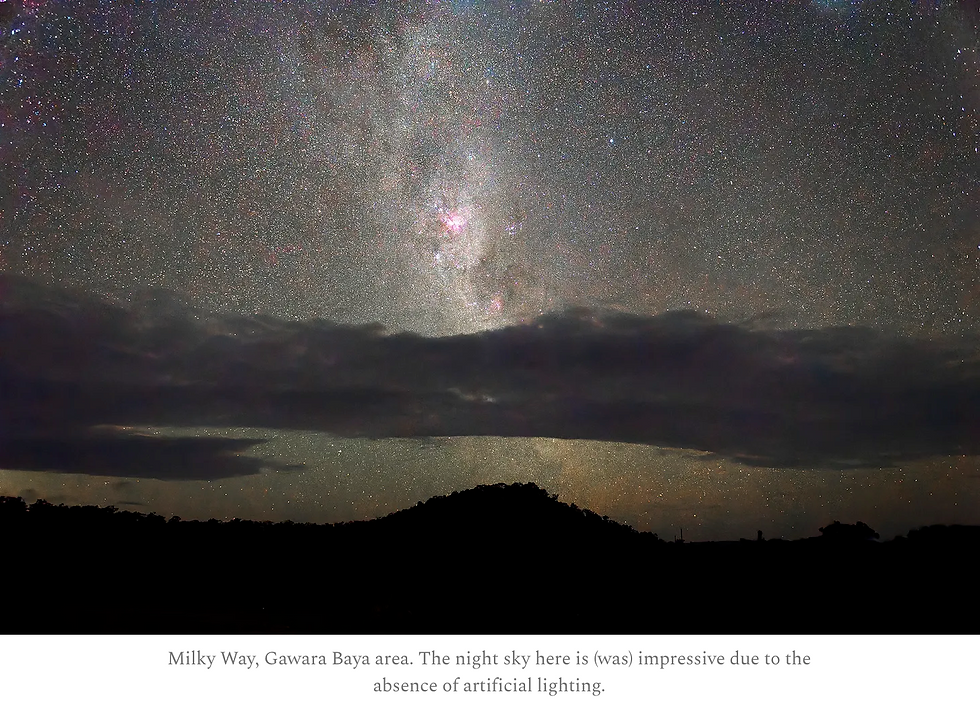
The proposed Chalumbin Wind Farm, further north, was withdrawn by Ark Energy in 2024 after they were advised of its impending rejection by the then Environment Minister, Tanya Plibersek. The main reason for its rejection seems to be its proximity to the Wet Tropics World Heritage Area (WTWHA) and its impact on species dispersing to adjacent areas, particularly the endangered Spectacled Flying Fox (SFF), which is an emblematic keystone species of the Wet Tropics.

Environmental Surveys commissioned by Windlab apparently did not find SFF colonies proximal to the proposed GBWF, but they did find a few individuals foraging at night along a watercourse to the south. They are frequently seen flying over nearby Mt Fox campground and feeding on nearby eucalyptus blossoms. In fact, a SFF camp was identified along the track to Raspberry Falls, in the nearby WTWHA (which is only around 4.7km from the nearest turbines), but the existence of this camp, about 6km from the nearest turbine, and within foraging range of all 68 turbines, has been ignored by the DCCEEW. Residents of the Mount Fox area have spoken of frequent visits by flying foxes raiding their fruit trees. In fact, one long-term Mt Fox resident has stated there was a colony of 600,000 flying foxes in the nearby area only 10 years or so ago.
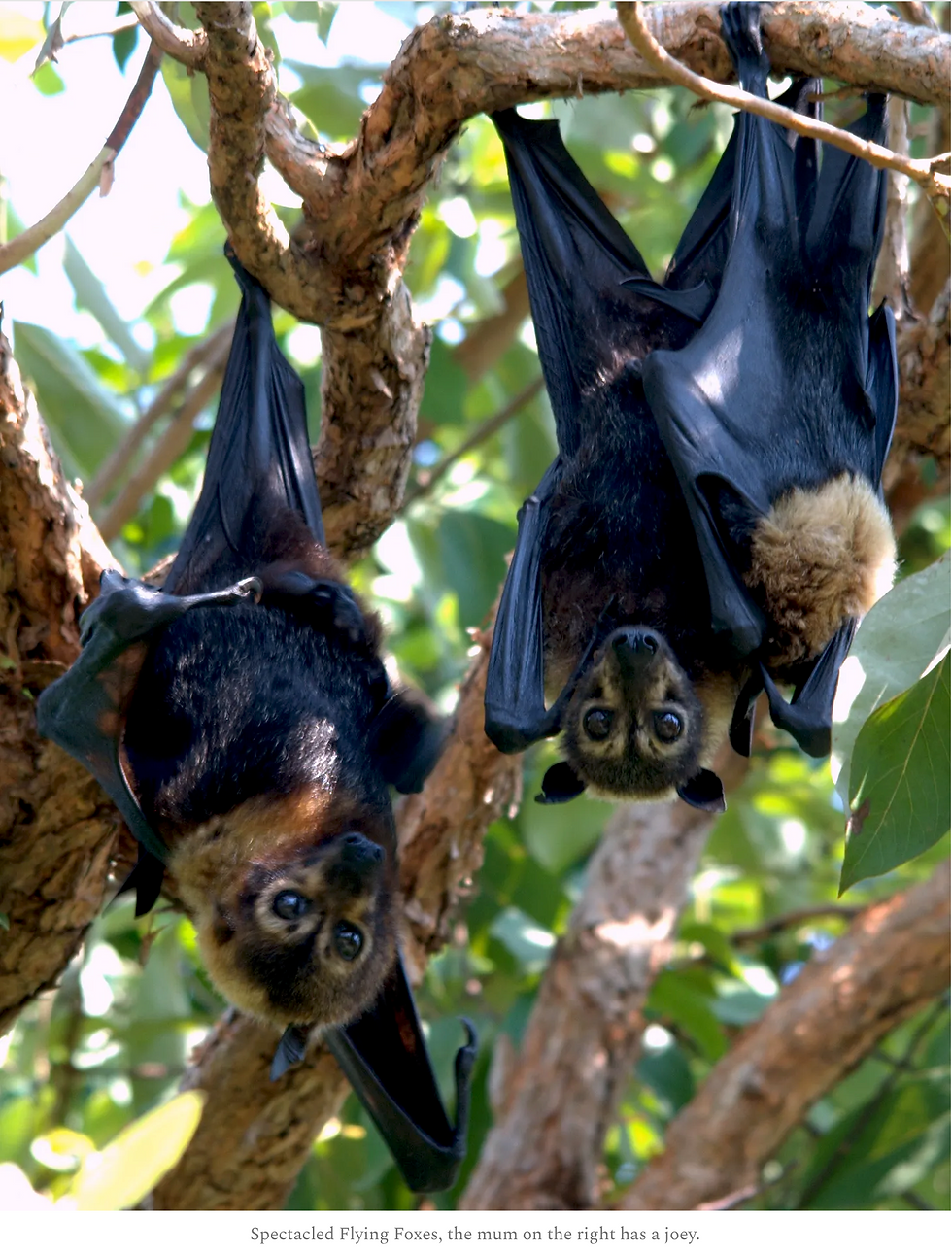
It is worth noting that at the Salt Creek Wind Farm in Victoria, 13 carcasses of the endangered Grey-Headed Flying Fox were found in one year, and total mortality is therefore estimated at around 40 individuals per year, which will obviously accumulate over the 20-year or so lifespan of the Wind Farm. The estimates are derived from surveyors’ carcass-detection rates and estimated carcass-persistence rates, which are affected by scavenging animals. Often, only a selection of turbines is actually surveyed. The carcass surveys are often only conducted for 1-2 years after commissioning and by workers contracted by the operators under non-disclosure agreements. Many species killed by wind turbines, including bats and raptors, are slow-breeders, and killing individuals may have flow-on effects greater than that mortality as it may result in the death of juveniles, impacting the next generation.

There are only relatively few “threatened ecosystems” listed under the EPBC Act. The threatened ecosystem, “Nationally protected Broad leaf tea-tree (Melaleuca viridiflora) woodlands in high rainfall coastal north Queensland”, was mapped to occur on the site according to DCCEEW mapping. However, the environmental consultancy stated that this ecosystem was not specifically threatened, as the melaleuca species (Melaleuca viridiflora) did not predominate. As with all survey findings, there has been no opportunity to independently confirm them, as the entire site lies on private property, and the DCCEEW has no interest in independently validating the findings of proponent-contracted environmental consultancies. However, areas of the same threatened ecosystem have been identified just outside the project area.

The approval included permissions to destroy critical habitat for many endangered and migratory species, such as 614 hectares for the Northern Koala, 614 hectares for Sharman’s Rock Wallaby, 598 hectares for the Northern Greater Glider, and 581 hectares for the Red Goshawk, Australia’s rarest raptor. Other affected species include the Northern Masked Owl, Spectacled Flying Fox, Bare-rumped Sheathtail Bat – colonies to the north and south will be isolated due to this project- and the Greater Large-Eared Horseshoe Bat, Magnificent Broodfrog, and White-Throated Needletail, which is commonly seen at this site from October to March and is thought to range up and down the ranges of the east coast of Australia and Tasmania multiple times every year following storm weather patterns, having migrated from Siberia to Australia each year. Notably, this location is one of the few in Australia where White-throated Needletail roosting behaviour has been observed. The approval conditions do not specify any measures to protect the Needletail’s roosting habitat, nor have any offsets been proposed. Wind turbines are now considered the main cause of death for this species in Australia, and it is in rapid decline, heading toward extinction.

The approval conditions also contain no specific approvals to alienate significant areas of habitat for endangered species due to noise and disturbance. Research in the Northern Hemisphere (yet to be done in Australia) has found that many species avoid proximity to wind turbines. The resultant area of habitat denial can include areas 5km or more from wind turbines for some species. Like direct habitat destruction, this habitat denial will inevitably kill many individuals of many species, as surrounding ecosystems have only a limited carrying capacity for any species.

The areas of direct habitat destruction for threatened species have been offset to supposedly negate harm to the species. But this does not negate harm to individuals, many of whom will likely die as a result. If you are a wind farm developer like Windlab, you get away with this indirect extermination scot-free. The offset areas are supposed to be “managed” so that the direct destruction of habitat in the project area is compensated for. This management can include changes in fire regimes to supposedly benefit certain species, weed management, feral pest management, and reduced cattle grazing. In the offset area, which was proposed as the main area where the destruction of Koala and Sharman’s Rock Wallaby habitat was to be offset, only one koala was found, compared to the 30 or so sightings of koalas or evidence of their presence in the project area. It was stated that it was unlikely that any change in fire management would be beneficial, that invasive weeds were not a particularly remediable issue in that area, and that removing them is unlikely to benefit koalas sufficiently; cattle grazing would continue, and there are presumably already measures in place to combat feral pests, such as 1080 baits and shooting, as is usually the case on cattle properties.

So how are the offset areas supposed to negate the obvious death of koalas from habitat destruction, let alone the likely alienation of habitat? Koala expert Dr Roger Martin (personal communication) has found that a tracked koala refused to come within 5 km of Kaban Wind Farm despite extensive suitable habitat being present in proximity to the wind farm. Windlab has never received permission to deny threatened species access to suitable habitat. If one were to map the area within 6 km of the closest turbine, the area of habitat alienation would approach 400 km2. This degree of habitat alienation has not been considered, nor has it been avoided, mitigated, or offset, as required for any significant impact on threatened and migratory species under the EPBC Act. Therefore, this project should be illegal under the EPBC Act, for this reason alone. The approval conditions state that offset areas are to be at least 6 km from wind turbines – it seems that the DCCEEW is aware of the issue of habitat alienation but refuses to consider it as a significant residual impact on threatened and migratory species. Because this significant impact has not been specifically approved, Windlab should, in theory, be subject to substantial fines upon operation of the wind turbines, and their operation subsequently prohibited, if DCCEEW is to be the impartial regulator, not facilitator, of environmental impacts.

The population of Northern Koala in the Mt Fox area lies predominantly within the proposed site of the Gawara Baya wind farm. It is thought that chlamydia likely affects a significant proportion of this koala population, which is likely important to the long-term survival of koalas due to the higher genetic diversity of more northern and inland populations. It seems likely that the extensive impacts of this wind farm will be the final nail in the coffin for this colony and contribute to the extinction of this species in the wild.

The offset area for the Northern Masked Owl, whilst deemed suitable habitat for this species by the environmental surveying consultancy, was found to contain no individuals – clearly, the best habitat lies within the project area, in proximity to the planned wind turbines. Owls cannot live near noisy wind turbines because they rely on their ultra-sensitive hearing to locate prey.

As for the endangered Sharman’s Rock Wallabies, this species inhabits only this area and a defined area to the south and south-east. It needs rocky boulder outcrops and gorge systems, and suitable habitat extends only as far south as the Mt Zero-Taravale Reserve. Destroying and alienating a significant area of habitat where this species is now common will surely place it at much higher risk of extinction. There is no information on the extent of likely habitat alienation by wind turbines for this species, and it is known that the network of new haulage roads will fragment existing populations and allow the introduction of much higher numbers of feral cats. Some of the area likely has never suffered from the incursion of this predator, being remote and previously inaccessible. This species will also likely be exterminated in this area. There are also a number of other wind farm projects proposed for boulder habitat nearby, where Sharman’s Rock Wallabies survive and thrive, including Mt Fox Energy Park, and proposed wind farms on nearby Kallanda, Hidden Valley, and Zig Zag stations to the south. Construction of the wind farm will require the blasting of rock wallaby boulder habitat in multiple areas, including hilltops and ridges. The approval conditions require an environmental surveyor to designate the habitat as free of rock wallabies; thereafter, Windlab is allowed 10 business days to clear and blast the habitat. The direct injury and mortality of rock wallabies returning to their dens in caves and crevices after being scared off by surveyors cannot be prevented with this approach, even though the approval conditions state that no killing of rock wallabies or other threatened species is allowed during construction. There will be no independent oversight of this. Rock Wallabies will possibly be blasted to kingdom come, but no one will know.
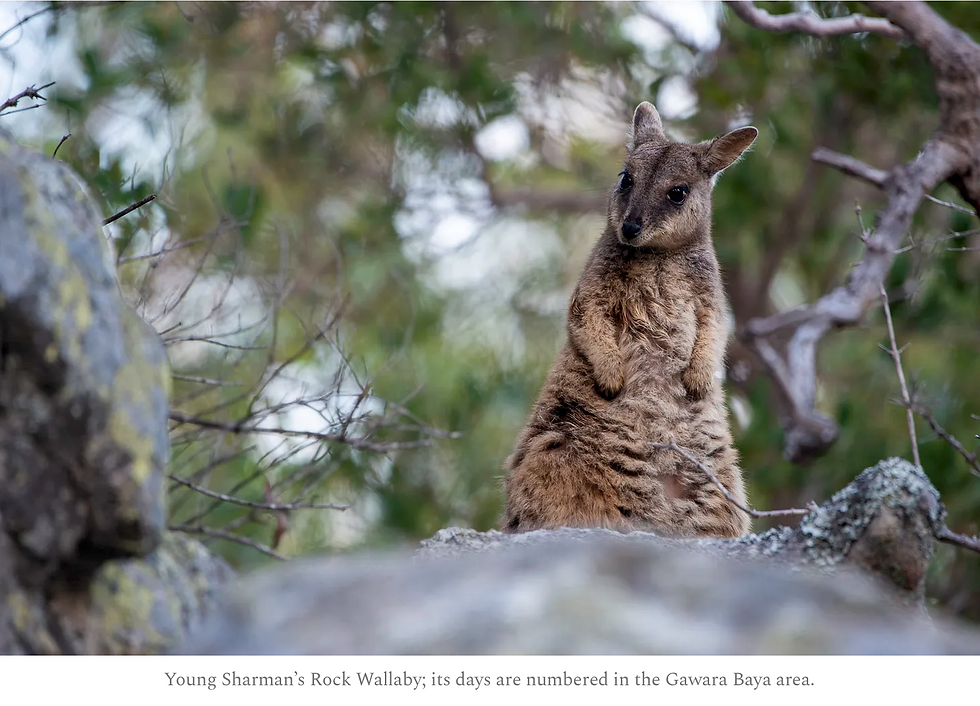
It should be noted that offset areas are protected from direct destruction only during the life of the wind farm. After decommissioning, with EPBC approval, they may also host a wind farm. Where does that leave the struggling populations of koalas, Sharman’s Rock Wallabies, Northern Greater Gliders and Red Goshawks? It really is a sham process, a licence to exterminate, but greenwashed by the Federal Government to be “nature positive”.

Windlab’s wind turbines are allowed to kill, by collision and barotrauma, a certain number of identified threatened and migratory species every year. Every year, the number is reset to zero, and there is no upper limit to cumulative impacts over the entire life of the wind farm, nor is there any limit to cumulative impacts of wind farms (and other developments) across the entire range of threatened and migratory species. Provided the mortality stays within the designated yearly total at each wind farm, everything is fine. They have permission to exterminate, with no risk of fines or imprisonment.

For Red Goshawks, being critically endangered, just one death, admitted by Windlab to the DCCEEW, is enough to provoke a response. However, the actual response has not been defined at the time of approval and may involve only temporarily closing down one or more turbines deemed to be at higher risk of killing Red Goshawks, presumably including the one that caused the death. This is just one example of sham pseudoscience employed by the developers in collusion with DCCEEW, as collisions are largely random and the tiny sample size cannot be used to draw any conclusions about the future likelihood of collisions with particular wind turbines, if indeed any Red Goshawks do survive in the area. And it’s too late for the individual killed – there has been no avoidance, mitigation or viable offset for that death, which will make contraction of their range more likely, as will the ultimate extinction of that species.

For other bird and bat species deemed likely to be killed by collision or barotrauma, the percentage of mortality permitted by this wind farm is arbitrarily set at 0.1% of the total Australian population. It is stated in the environmental documentation: “These thresholds have been set based on the concept that an annual fatality rate of >0.1% of the population would cause serious disruption to an ecologically significant proportion of that population and would therefore be significant. This is consistent with the approach adopted at other wind farms.” There has been absolutely no scientific study confirming this approach for specific species, and it does not account for cumulative impacts. A study in the Netherlands found that mortality from wind farms causes significantly greater population reductions than the direct mortality would indicate – the mortality actually multiplies over time.
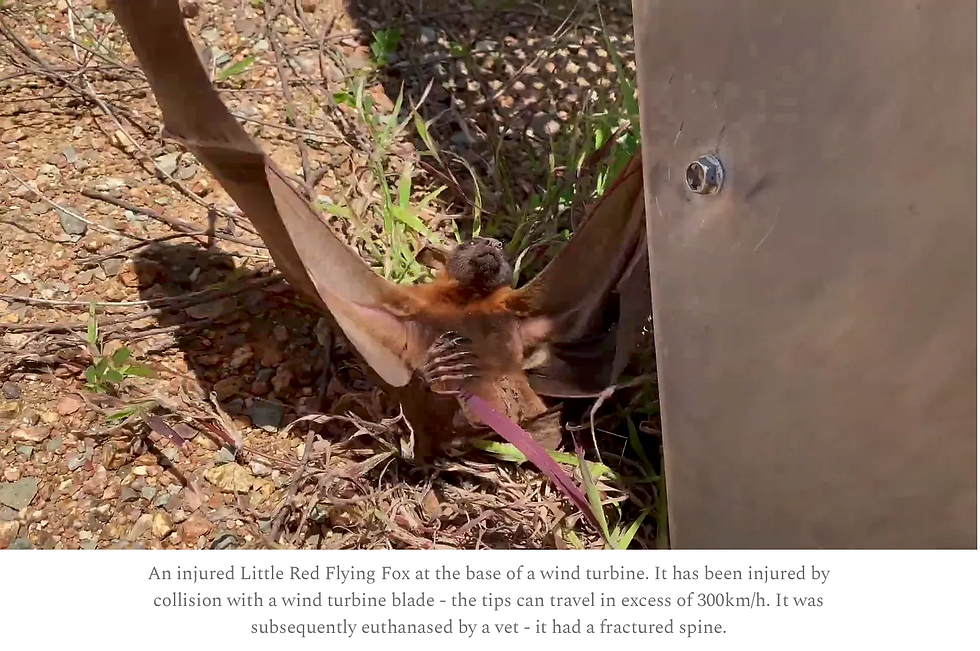
Windlab is permitted to kill up to 92 SFFs each year, based on a population estimate published 11 years ago, and does not account for subsequent declines in this species or local population sizes. They are also allowed to kill 680 Grey-Headed Flying Foxes every year. Windlab is allowed to kill 10 Bare-rumped Sheathtail Bats every year, and this number does not account for the direct destruction of roosting and foraging habitat by the wind farm. Windlab is allowed to kill 41 individuals of the White-Throated Needletail each year, even though the Australian population is not accurately known and the population estimate is derived entirely from witnessed flock sizes, not also the number of flocks, with no peer-reviewed scientific paper to validate this estimate. Windlab is allowed to kill 41 Pacific Swifts every year at this site, even though there is no population estimate for this migratory species, and 30 Latham’s Snipe, a migratory species of wader which typically inhabits marshy open forested areas. No quota applies to other threatened and migratory species deemed to be of low risk of collision, such as the Eastern Osprey, Northern Masked Owl, Greater Large-Eared Horseshoe Bat, and other species not identified in the area by the environmental surveyors, such as the Ghost Bat. They can kill as many as they want.

As stated above, killing numbers in excess of the allowed mortality will generally only cause the stoppage of a limited number of turbines, which can be restarted with Ministerial approval. At Kaban Wind Farm, a mortality threshold was exceeded, but the required response was only continued “monitoring”.
A total of 136 bird and 27 bat species were found inhabiting the GBWF site. Of note, non-threatened species known to fly at heights where collisions and barotrauma are likely include the Wedge-tailed Eagle and other raptors, Rainbow bee-eater, Koel, Channel-billed Cuckoo, Dollarbird, Gould’s wattled bat, White-striped freetail bat, Little red flying fox, Greater northern free-tailed bat, Northern free-tailed bat, Ride’s free-tailed bat, Yellow-bellied sheath-tailed bat, and Troughton’s sheath-tailed bat. Many individuals of these species will die as a result of collisions and barotrauma, some in large numbers. This is entirely permitted under the EPBC Act, as they are not considered endangered or listed as migratory species at present. (Wind turbines are now considered the greatest cause of mass mortality of bat populations globally.) However, ongoing mortality from this and other wind farms will no doubt cause population declines and future local extinctions of many species. Mt Emerald Wind Farm to the north admitted to killing 3 Wedge-tailed Eagles one year and 4 the next. This level of ongoing population impact is enough to jeopardise entire local populations, as has happened in Tasmania.

The Gawara Baya Wind Farm really does have a licence to exterminate many threatened and migratory species. There is no climate benefit to this project, as its contribution to emissions reduction has been grossly overestimated. To replace baseload fossil fuel generation, huge amounts of electrochemical storage are required, enough to cover wind droughts of several days at a time, which are common in this area, and to multiply generation capacity to replenish it, resulting in gross fragmentation and destruction of carbon sinks and carbon sequestration capacity, for both critical minerals mining and the deployment of this and other wind farms. This project will not negate climate change but add to it. The lesser of climate evils is still evil, whichever that is. Renewables actually require fossil fuel (gas) expansion for balancing and reserve generation capacity, as well as massively expanded mining of critical minerals, many of which are suffering declining grades and therefore increasing emissions from mining and processing. Critical minerals mining is destroying carbon sinks and causing massive numbers of species declines and extinctions in many countries. Peer-reviewed science has shown that wind turbines with rare-earth magnets (such as Goldwind’s, utilised by Squadron Energy at Clarke Creek and likely to be used here, and certain Vestas models, to be utilised at Lotus Creek WF) have end-of-life emissions approaching those of gas electricity generation, excluding the emissions from biomass destruction and fragmentation, the loss of carbon sequestration, and the emissions of balancing gas generation and electrochemical storage. Not to mention more growth, which science says simply cannot be green, as it requires more fossil fuels and the destruction of carbon sinks. But economic growth is mooted as a benefit of this project. To say this project benefits the climate is simply greenwashing, which, according to the ACCC, is illegal.
This project is untenable and inconsistent with Australia’s commitments to both World Heritage Areas and the Kunming-Montreal Protocol of the Convention of Biological Diversity. It must be rejected. It’s not too late.
We call on potential investors in this project to solemnly consider whether your corporation’s image should be tarnished by this destructive and unsustainable ecocide and multiple species’ extinctions, with increased climate harms, not benefits.
Additional Points:
In detail, approval condition 12 states: “To avoid and mitigate harm to protected matters, the Approval Holder must not kill or injure any Sharman’s Rock Wallaby, Greater Glider (northern), Masked Owl (northern), Koala, Red Goshawk, Grey-headed Flying Fox, Spectacled Flying Fox, Greater-Large-eared Horseshoe Bat, Bare-rumped Sheathtail Bat, White-throated Needletail, Fork-tailed Swift or Magnificent Brood Frog when undertaking clearing, construction or decommissioning”. How this approval condition can be complied with is uncertain and deeply troubling. For example, a non-independent surveyor (contracted, under a non-disclosure agreement) is to declare Sharman’s Rock Wallaby habitat free of Sharman’s Rock Wallabies, and then Windlab has no less than 10 business days in which to clear and blast this habitat. I know for a fact that when humans are in proximity of rock wallaby denning habitat, and it’s the same for any rock wallaby species, the individuals will flee and scatter away from the human presence. Can the habitat then be declared free of rock wallabies, when it is likely that the rock wallabies will return when the human/s leave the area? How can the avoidance of injury and death of Sharman’s Rock Wallabies and other species be reasonably assured? This condition is impossible to comply with and relies on absent independent oversight and non-existent enforcement. Many other endangered and threatened species are also at definite risk from construction activities.

The approval condition 24 states that “The Approval Holder must not clear or construct or undertake decommissioning activities within 450 metres of occupied Sharman’s Rock Wallaby Breeding Habitat from the commencement of the Action until the expiry of this approval.” Again there is no truly independent oversight of surveying which judges whether occupation of breeding habitat by Sharman’s Rock Wallabies exists within 450m of proposed clearing and infrastructure. Of grave concern, the area of denning (breeding) Sharman’s Rock Wallaby habitat seems to have massively constricted according to mapping by the latest consultancy company, Umwelt.
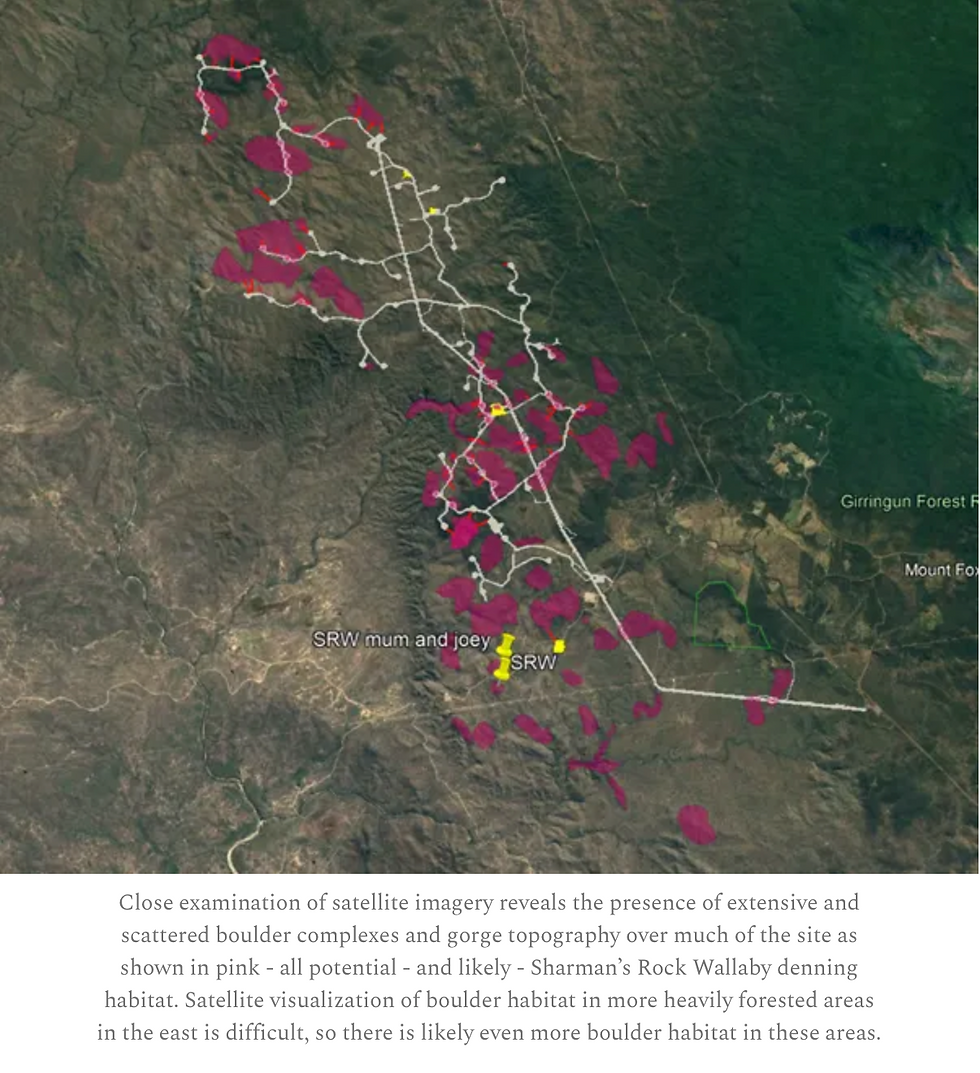
The maps that were lodged with the approval conditions show the existence of large areas of denning habitat (boulder complexes and rough rocky boulder-dominated terrain in gorges) scattered throughout the project area, and this is confirmed by examination of satellite imagery. Initial documentation of ground-truthing surveys also confirmed the existence of large numbers of Sharman’s Rock Wallabies and areas of denning habitat throughout the project area. It now seems much of this habitat has been judged to not be occupied breeding Sharman’s Rock Wallaby habitat. How convenient. Also the approval conditions have inserted the word “breeding” instead of “denning”, despite the routine use of “denning” in environmental documentation of this project. This is essentially the same thing but possibly allows habitat to be judged “non-breeding” if no mothers and joeys are visualized, despite it obviously being denning habitat. Possibly another case of regulatory capture.


Condition 56 states: “To repair and mitigate harm to protected matters, at the 65th anniversary of the date of this approval the Approval Holder must ensure all cleared areas in the Development Corridor have been revegetated such that native vegetation species, structure and density present prior to clearing have been re-established.” Condition 56 requires not just basic ground cover or “some vegetation,” but the full pre-clearance species composition, vertical structure (canopy, mid-storey, understorey), and density to be re-established across all cleared areas (including ridgelines, access roads, hardstands, and turbine pads) within that timeframe (by the year 2089). This is highly problematic, and exceedingly unlikely, especially for the Mount Fox / Upper Burdekin landscape:
Rocky boulder / outcrop habitats for Sharman’s rock-wallaby cannot be recreated on this timescaleSharman’s rock-wallaby (Petrogale sharmani) depends on complex boulder piles, rock crevices, overhangs, and stable rocky slopes for shelter, thermoregulation, and predator protection. These features develop over geological timescales through weathering, rockfall, and erosion.Blasting and heavy machinery during construction permanently alter or destroy this structure (compaction, crushing, removal of boulders, changed drainage and microclimates). Artificial “rock piles” rarely replicate the stability, crevice complexity, or lichen/moss cover of natural formations.Recovery plans and ecological studies for rock-wallabies (including related species like brush-tailed and Proserpine rock-wallabies) emphasise protection of existing habitat because creating or restoring equivalent rocky refuges is extremely difficult and has not been demonstrated at scale. No credible scientific literature shows successful restoration of functional boulder habitat for Petrogale species within decades.
Soil loss and degradationRidgeline clearing and road construction in steep, erosive tropical/subtropical terrain typically causes significant topsoil loss, especially during wet-season events. Soil formation in such environments is slow (often centuries for meaningful depth and structure). Without the original soil profile, seed bank, and mycorrhizal networks, it is extremely difficult to re-establish the original vegetation density and structure.
Timeframes for ecological recovery
In Australian eucalypt woodlands and open forests (the general vegetation type here), full recovery of species composition, structure, and density after heavy disturbance often takes many decades to centuries, and sometimes fails entirely. Studies show that even after 80–100 years, recovering sites may only reach 70–75% of reference condition in species richness and structure, with some areas showing outright regeneration failure.
In areas with permanent infrastructure (foundations, compacted roads, hardstands), full removal and restoration to pre-clearance condition is rarely achieved. Even “progressive rehabilitation” during construction usually results in simplified vegetation (grasses/shrubs) rather than the original complex woodland structure.
Tropical and subtropical systems with slow-growing trees (e.g., ironbarks, bloodwoods, figs) and specific understorey (kangaroo grass, etc.) simply do not mature to pre-disturbance condition in 35 years post-decommissioning.
Compounding factors
Climate variability, fire regimes, feral predators, and weeds can further delay or derail recovery.
The condition applies to all cleared areas in the Development Corridor, including those that will have had heavy industrial use for 30–40 years.
There is no strong precedent in Australia for wind farms (or similar linear/ridgeline developments) achieving full pre-clearance vegetation structure and species composition within 30–40 years after decommissioning.
It is clear that this approval condition simply cannot be complied with - it is simply impossible to rehabilitate all cleared areas and blasted and excavated and concreted areas back to pre-clearance state at around 35 years post-commissioning.
“Compliance” with this approval condition relies on no direct objective oversight, no enforcement, and regulatory capture.
Additionally, the proponent has not set aside a surety or bond to cover the costs of decommissioning and rehabilitation. Information from Terrain NRM regarding the Chalumbin wind farm proposal to the north suggested it would cost around $60,000 to $70,000 per hectare to have a reasonable chance of successful rehabilitation, though of course this would still take much longer than 35 years. Data from the USA points to the cost of decommissioning individual wind turbines as being around US$500,000; Agforce has stated in submissions they believe the cost would be $250,000 to $750,000 per turbine as of 2023.
If we take the mid values of both estimates, then the cost would be around $73 million, and this is the amount that the proponent should set aside in an escrow type account to assure that decommissioning and rehabilitation will be undertaken. This should be done with full transparency rather than any vague and opaque “undertakings”. The real amount in 30 years may well be 50%-100% more than this, perhaps even more, so $73 million should be the minimum set aside.
There are many issues with compliance to approval conditions which I will post in a comprehensive separate document which has already been sent to the DCCEEW and Queensland’s SARA, with no response.
Addendum: It appears that Andrew Forrest has sold is share in Windlab, which is now 100% owned by Federation Asset Management, which bought Forrest’s 75% stake with the help of Ares Management (a US-based equity fund).
To read article in Substack go here: https://michaelseebeck.substack.com/p/the-epbc-approval-of-the-gawara-baya


Comments